How many people use a free VPN?#
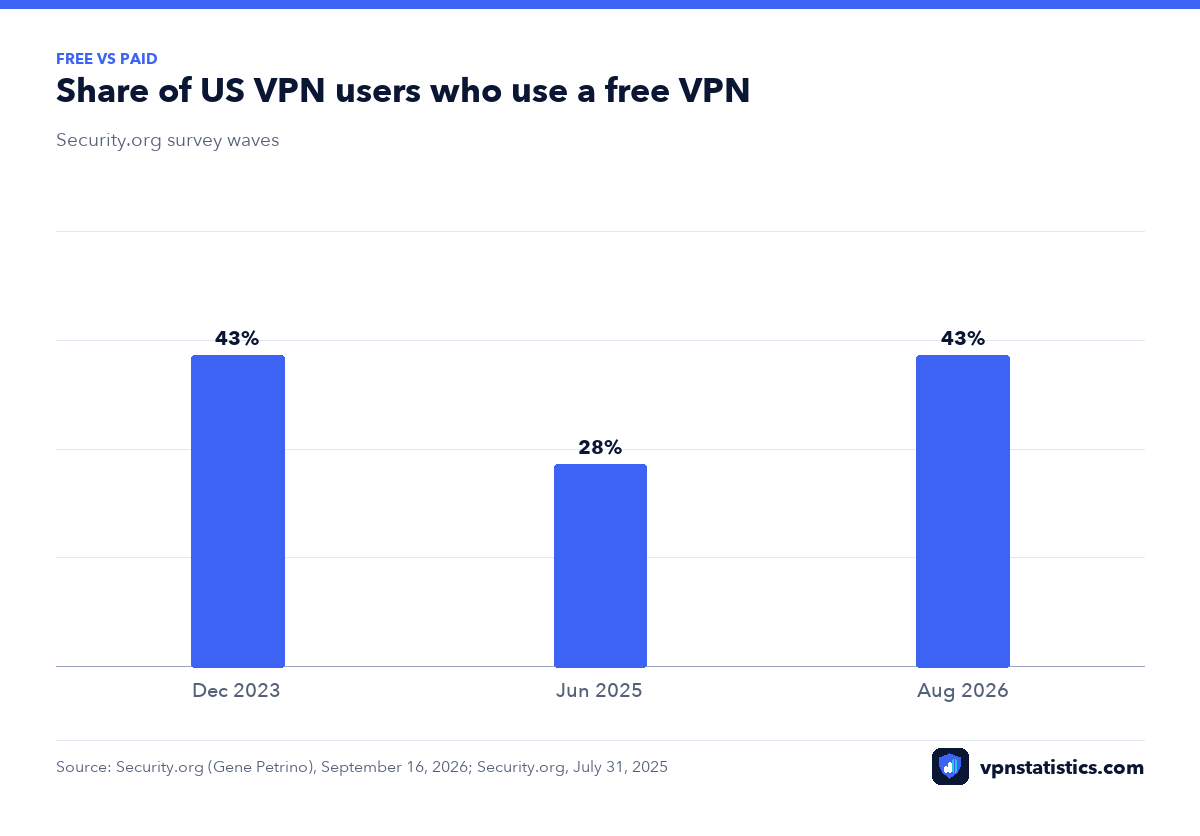
43% of US VPN users rely on a free VPN, according to Security.org’s August 2026 survey, up from 28% in 2025.[1]
Share of US VPN users who use a free VPN
Security.org survey waves
Show data table
| Fieldwork | Share using a free VPN |
|---|---|
| Dec 2023 | 43% |
| Jun 2025 | 28% |
| Aug 2026 | 43% |
The share has swung between 28% and 43% across three survey waves of about 1,000 adults each, so the exact level is uncertain. In all three waves, at least 28% of US VPN users used a free service.
What a 2026 study of 281 VPN apps found#
Researchers from the University of Michigan, the University of New Mexico and IIT Delhi tested 281 popular Android VPN apps from Google Play. Of those, 61 sent some data unencrypted.[3]
Problems found in 281 Android VPN apps (NDSS 2026)
| Finding | Apps |
|---|---|
| Sent some data unencrypted | 61 |
| Sent VPN configuration files in cleartext | 5 |
| Leaked traffic outside the tunnel (including DNS) | 29 |
| Sent the device’s advertising ID | 76 |
| Had insecure configuration practices | 107 |
| Did not obfuscate VPN traffic, so it is easy to detect and block | 169 |
Source: Wang et al., MVPNalyzer, NDSS Symposium 2026.[3]
Press coverage called them free apps; the paper says only “popular.”
The 2016 study that is still quoted#
A 2016 study by Australia’s CSIRO Data61, the University of New South Wales and the International Computer Science Institute (ICSI) examined 283 Android apps that used the VPN permission.[4]
of 283 Android VPN apps tunneled traffic without encryption.[4]
did not tunnel IPv6 traffic, and about 66% did not tunnel DNS traffic.[4]
used third-party tracking libraries.[4]
had at least one antivirus flag on the malware-scanning service VirusTotal; only about 4% were flagged by more than five engines.[4]
The “38% contain malware” line is widely repeated, often without the caveat. Among the most-flagged apps, adware was the most common type (43%), followed by trojans (29%). The study was published in 2016.
Free VPNs with hidden owners#
In April 2025 the Tech Transparency Project found that 20 of the top 100 free VPN apps in Apple’s US App Store (ranked by 2024 US downloads) were owned by companies in mainland China or Hong Kong that did not clearly disclose it. Those apps had been downloaded more than 70 million times in the US.[5]
A follow-up check in May 2025 found 13 China-owned VPN apps still on Apple’s US App Store and 11 on Google Play.[6]
Free VPN data exposures#
Reported data exposures involving free VPN apps
| Service | Reported | What was exposed | Status |
|---|---|---|---|
| SuperVPN, GeckoVPN, ShieldVPN | May 2023 | 360,308,817 records (133 GB) in an unprotected database | Reported |
| BeanVPN | Jun 2022 | 25 million+ records (18.5 GB of connection logs) | Reported |
| SplitVPN (formerly NotVPN) | Jul 2026 | 23.4m user records and about 58m connection logs offered for sale | Alleged, unconfirmed |
Sources:[7][8][9] The SuperVPN and BeanVPN exposures date from 2023 and 2022, though some websites present them as recent.
Questions about free VPNs#
How many people use free VPNs?
Are free VPNs safe?
Do free VPNs contain malware?
Sources
Numbered sources match the superscripts on this page. We link to the original publisher wherever one exists. How we check figures · Report an error
- Security.org (Gene Petrino). VPN Use in 2026: Trends, Statistics, and Consumer Sentiment, September 16, 2026. 1,008 US adults, online panel, August 2026, unweighted, margin of error ±3.1 points.
- Security.org. VPN Use in 2025 (archived copy), July 31, 2025. 1,009 US adults, June 2025.
- Wang et al., Network and Distributed System Security (NDSS) Symposium. MVPNalyzer: An Investigative Framework for Auditing the Security & Privacy of Mobile VPNs, 2026.
- Ikram, Vallina-Rodriguez, Seneviratne, Kaafar and Paxson (IMC 2016). An Analysis of the Privacy and Security Risks of Android VPN Permission-enabled Apps (PDF), 2016.
- Tech Transparency Project. Apple offers apps with ties to Chinese military, April 1, 2025. Download counts from AppMagic.
- Tech Transparency Project. Spot check: Apple and Google still have a Chinese VPN problem, June 12, 2025.
- Cyber Daily. 360 million records exposed in free VPN data breach, May 2023.
- Infosecurity Magazine. BeanVPN leaks 25 million user records, June 2022.
- Bitdefender HotForSecurity. Alleged SplitVPN breach: 58 million connection logs, July 30, 2026. Alleged; not confirmed by the company.